Sharing Female Wisdom

In a way I view my blog as a scrapbook and a place to gather interesting information, thoughts, links, and resources. I hope it can act as a library for those of you also seeking to grow as feminine women. Below I’ve shared several videos by different women who I think have wisdom to share on a range of topics. Clearly there are too many videos to listen to in one sitting, but if femininity is a topic that interests you, then this list is worth coming back to when you have time. There is much to be learnt from listening to the ideas and experiences of other women, and I wanted to share some voices you may not otherwise come across. I hope you can learn something of interest from them.

A Call to Restore Femininity

Experiences of a Muslim Woman

The Purpose of Bras

Feminine Traits of God

‘Happy African Feminism’

Dangers Facing Black Women

Female Nutrition & Sports Science

Making New Friends

Romantic Relationship Advice

Media Depictions of Femininity

The Wisdom in Women’s Fury

A Christian Girl’s Faith Journey

Women’s Need for Courage

Becoming a More Feminine Woman

‘Being female is a matter of birth. Being a woman is a matter of age. Being a lady is a matter of choice.’

Anonymous

‘Do not live someone else’s idea of womanhood. Womanhood is you.’

Viola Davis

‘We start marketing to women and we start marketing to men, and it all of a sudden becomes, the aim becomes this biblical womanhood, biblical manhood. The aim isn’t that – I’m already a woman! My aim is to be a disciple of Christ. My aim is eternal communion with the triune God and one another.’

Aimee Byrd

What does it mean to become a more feminine woman? It’s been nearly one and a half years now since I started writing Feminine Finishing School and contemplating this question. I think healthy femininity comes from being strong in our gentleness and embracing both aspects of that. There are fun adornments we can add to express our femininity such as beautifying our appearance, learning etiquette, and developing creative skills, but those are not the most important part of femininity. Our first aim should be growing in Christlikeness, and then we can add extra accomplishments that match our personal expressions of femininity.

Feminine women are not separated from masculine men or anyone else. We are all humans who should strive to be true images of God. Our goal should be to develop the fruit of the Holy Spirit (Galatians 5:22-23): love, joy, peace, patience, kindness, goodness, faith, gentleness, and self-control. Most important of all is that we are living witnesses of God’s love. We should love God with all our heart, all our soul, all our mind, and all our strength, and we must love our neighbours as ourselves (Mark 12:30-31). If we don’t love, then is doesn’t matter how beautiful we may appear or how charming or sophisticated we may seem through etiquette. Love is the most important and should be the source of our femininity.

‘If I speak in the tongues of men or of angels, but do not have love, I am only a resounding gong or a clanging cymbal. If I have the gift of prophecy and can fathom all mysteries and all knowledge, and if I have a faith that can move mountains, but do not have love, I am nothing. If I give all I possess to the poor and give over my body to hardship that I may boast, but do not have love, I gain nothing.

Love is patient, love is kind. It does not envy, it does not boast, it is not proud. It does not dishonour others, it is not self-seeking, it is not easily angered, it keeps no record of wrongs. Love does not delight in evil but rejoices with the truth. It always protects, always trusts, always hopes, always perseveres.’

1 Corinthians 13:1-7

However, with that said and established as a foundation, stepping from childhood into mature femininity requires some guidance. Femininity offers a unique power of its own and is a life-long journey of self-growth. A woman is a girl who’s grown up, defined by her strength and experience, rather than someone defining themselves in opposition to men. I’ve written blog posts before about what I consider to be the keys to healthy femininity, but the question is: how is that expressed in the different stages of female experience?

The Feminine Journey

Girl, noun – ‘A female child. The counterpart of boy.’ or ‘A young or relatively young woman.’ First recoded circa 1300.

Oxford English Dictionary

Woman, noun – ‘An adult female human being. The counterpart of man.’ and ‘With specific reference to age: a female person who has reached adulthood… female person who is considered mature. Frequently contrasted with girl.’ Origins from early Old English

Oxford English Dictionary

Lady, noun – ‘Originally used as a polite form of address to a woman, especially (in early use) to one of elevated or higher social standing.’ or ‘A woman having the characteristics traditionally associated with high social standing; a refined or genteel woman.’ or ‘The female head of a household; a woman who has authority over servants.’ or ‘A woman who is the object of (especially chivalrous) love or devotion.’ Origins from early Old English.

Oxford English Dictionary

The Power of Femininity

Femininity is a woman’s power that comes from being true to herself while stepping into her life-giving qualities. A feminine woman is authentic and honest, unafraid of expressing her true self, and seeks to positively contribute to the world around her through life-giving qualities such as kindness, compassion, creativity, wisdom, and joyfulness. She seeks to improve herself to grow towards her potential, whilst having grace towards any mistakes she may have made in the past. Femininity means cultivating Christlike qualities and celebrating her existence as a woman. She aims to bring metaphorical life to the people and situations she encounters, not metaphorical death. She works to overcome death-bringing qualities such as unkindness, injustice, gossip, bullying, impatience, bitterness, and selfishness. Femininity manifests in different ways at different stages of life. It’s also expressed in diverse ways according to the individuality of each women. However, the core essence of femininity is the same: embracing the strength in your gentleness, finding authenticity through being unafraid of your vulnerabilities, and seeking to bring metaphorical life into the world.

Becoming a Good Woman

Stepping into adulthood and transitioning from a girl into a woman means learning our inner strength and accepting responsibility to take on whatever life throws at us. Being a woman means experiencing the highs and lows of life, the triumphs and failures, the love and the pain of living, and trusting we will get through somehow even when things don’t go as planned. Being a woman means having a self-assurance in knowing our self and our basic values, knowing what we will and will not compromise. It means being able to participate independently in our society, accepting adult responsibility, and caring for those we’ve been entrusted with in life.

Becoming a True Lady

Choosing to become a lady means further developing the social graces, education, consideration for others, leadership skills, knowledge of etiquette, self-awareness, and poise to become a considerate leader. Whereas a woman has embraced the power within herself to become autonomous and influence her family, a lady continually improves and refines herself and has further discovered how to influence her wider community or society. A feminine woman knows herself and positively influences her family. A feminine lady seeks to always grow herself and positively influence her wider society. Good women and ladies share the same feminine power, but true ladies have developed and expanded that feminine power to another level.

Summary

Girls are children and are led by their parents and teachers as they learn about the world around them. Women are adults and are able to lead themselves in that world. True ladies are committed to self-improvement and have learnt to lead not just themselves but also their communities towards becoming and creating a better world.

‘If’ Poems for Girls

Rudyard Kipling’s poem ‘If—’ has been highly popular and achieved cultural-artefact status in Britain. It was written around 1895 and addressed to his son, advising him on how to become a man of character and integrity. Ever since its publication in 1910, ‘If—’ has inspired many parodies or imitations. Several of these have transformed the paternal advice into poems speaking to daughters about womanhood. Some of these adaptations have more helpful messages than others.

Below I have shared the original poem and three versions addressed to girls. The first is by J P McEvoy, an American writer, who published his ‘“If” for Girls’ in 1924. The second is Elizabeth Lincoln Otis’ poem ‘An “If” for Girls’ from 1931. Finally is Irish poet Alice Kinsella’s poem ‘When’, which she wrote for International Women’s Day in 2017, and which was then performed by a group of 16 different female poets. Whilst Rudyard Kipling’s ‘If—’ is addressed to his son, the advice can perhaps equally apply to girls. Each of these writers has a different interpretation of advice for daughters, and it is interesting to note the differences.

‘If—’ by Rudyard Kipling (1895)

In writing ‘If—’ Rudyard Kipling was inspired by Scottish colonial politician Leander James Starr, who was made the scapegoat of the failed Jameson Raid that brought about the Boer War a few years later from 1899-1902. The poem is an example of Victorian-era stoicism, self-discipline, and the British cultural virtue of a stiff upper lip. It celebrates heroism, dignity, stoicism, fortitude, self-discipline, resolution, integrity, inner strength, and courage in the face of disaster.

‘If you can keep your head when all about you
Are losing theirs and blaming it on you,
If you can trust yourself when all men doubt you,
But make allowance for their doubting too;
If you can wait and not be tired by waiting,
Or being lied about, don’t deal in lies,
Or being hated, don’t give way to hating,
And yet don’t look too good, nor talk too wise:

If you can dream—and not make dreams your master;
If you can think—and not make thoughts your aim;
If you can meet with Triumph and Disaster
And treat those two impostors just the same;
If you can bear to hear the truth you’ve spoken
Twisted by knaves to make a trap for fools,
Or watch the things you gave your life to, broken,
And stoop and build ’em up with worn-out tools:

If you can make one heap of all your winnings
And risk it on one turn of pitch-and-toss,
And lose, and start again at your beginnings
And never breathe a word about your loss;
If you can force your heart and nerve and sinew
To serve your turn long after they are gone,
And so hold on when there is nothing in you
Except the Will which says to them: ‘Hold on!’

If you can talk with crowds and keep your virtue,
Or walk with Kings—nor lose the common touch,
If neither foes nor loving friends can hurt you,
If all men count with you, but none too much;
If you can fill the unforgiving minute
With sixty seconds’ worth of distance run,
Yours is the Earth and everything that’s in it,
And—which is more—you’ll be a Man, my son!’

‘If—’ by Rudyard Kipling (1895)

‘”If” for Girls’ by J P McEvoy (1924)

J P McEvoy’s ‘”If” for Girls’ seems to me to be the most similar in tone to Rudyard Kipling’s original poem, however the adaptation has messages of its own. ‘”If” for Girls’ has a more domestic and relational approach. It encourages hopefulness in all circumstances, humility, gentleness, moderation, appropriate boundaries, and a strong faith that empowers girls to assert themselves and stand up for what they believe to be right. Notably, it has a more overtly Christian perspective that points girls to seek God in all circumstances of life.

‘If you can hear the whispering about you,
And never yield to deal in whispers, too;
If you can bravely smile when loved ones doubt you,
And never doubt, in turn, what loved ones do;
If you can keep a sweet and gentle spirit
In spite of fame or fortune, rank or place,
And though you win your goal or only near it,
Can win with poise and lose with equal grace;

If you can meet with Unbelief, believing,
And hallow in your heart a simple Creed,
If you can meet Deception, undeceiving,
And learn to look to God for all you need;
If you can be what girls should be to mothers:
Chums in joy and comrades in distress,
And be unto others as you’d have the others
Be unto you – No more, and yet no less;

If you can keep within your heart the power
To say that firm, unconquerable “No”;
If you can brave a present shadowed hour,
Rather than yield to build a future woe;
If you can love, yet not let loving master,
But keep yourself within your own self’s clasp,
And not let dreaming lead you to disaster,
Nor pity’s fascination loose your grasp;

If you can lock your heart on confidences,
Nor ever needlessly in turn confide;
If you can put behind you all pretenses
Of mock humility or foolish pride:
If you can keep the simple, homely virtue
Of walking right with God – then have no fear
That anything in all the world can hurt you-
And – which is more – you’ll be a Woman, dear.’

‘”If” for Girls’ by J P McEvoy (1924)

‘An “If” for Girls’ by Elizabeth Lincoln Otis (1931)

Little is known about Elizabeth Lincoln Otis. Her poem ‘An “If” for Girls’ contains some good advice, yet it also comes across as rather patronising and sexist by today’s standards. The poem is focused on external accomplishments over inner character, promoting high requirements for some ideal of perfection. The skills it recommends are good things to learn and some of them were likely considered progressive in her own time. However, the poem’s focus remains limited to becoming a pleasing wife and good mother, prepared to accommodate the wishes of men. For example, the poem’s ideal woman should be able to dance but must not have ‘a craze for dancing’, because to have her own passionate hobbies or interests would be an inconvenience to the men in her life. Being a good wife, mother, and homemaker are admirable goals, but girls should be encouraged to explore their own interests rather than try to fit into some mould.

‘If you can dress to make yourself attractive,
Yet not make puffs and curls your chief delight;
If you can swim and row, be strong and active,
But of the gentler graces lose not sight;
If you can dance without a craze for dancing,
Play without giving play too strong a hold,
Enjoy the love of friends without romancing,
Care for the weak, the friendless and the old;

If you can master French and Greek and Latin,
And not acquire, as well, a priggish mien,
If you can feel the touch of silk and satin
Without despising calico and jean;
If you can ply a saw and use a hammer,
Can do a man’s work when the need occurs,
Can sing when asked, without excuse or stammer,
Can rise above unfriendly snubs and slurs;
If you can make good bread as well as fudges,
Can sew with skill and have an eye for dust,
If you can be a friend and hold no grudges,
A girl whom all will love because they must;

If sometime you should meet and love another
And make a home with faith and peace enshrined,
And you its soul—a loyal wife and mother—
You’ll work out pretty nearly to my mind
The plan that’s been developed through the ages,
And win the best that life can have in store,
You’ll be, my girl, the model for the sages—
A woman whom the world will bow before.’

‘An “If” for Girls’ by Elizabeth Lincoln Otis (1931)

‘When’ by Alice Kinsella (2017)

Alice Kinsella’s poem ‘When’ immediately strikes a more confident, assured tone just from the title. It is no longer a case of ‘If’ but ‘When’. Her feminist poem feels the injustices of life and recognises that daughters will be hurt, yet promotes an inner strength and fire of a fighting spirit that will never give up on what is right regardless. In her poem, women know their vulnerability as well as their power, and are supportive as a sisterhood to every other woman. Becoming a worthy woman is a process that comes more from experiencing life as a woman and refusing to give up, rather than from the specific accomplishments of other poems. Being a woman is a lived experience rather than ‘some myth of virtue’. The world unfortunately will try to break women down, but they must learn to get up again and still laugh at the days to come.

‘When you can say the words that are not listened to
But keep on saying them because you know they’re true;
When you can trust each other when all men doubt you
And from support of other women make old words new;
When you can wait, and know you’ll keep on waiting
That you’ll be lied to, but not sink to telling lies;
When you know you may hate, but not be consumed by hating
And know that beauty doesn’t contradict the wise;

When you can dream – and know you have no master;
When you can think – let those thoughts drive your aim;
When you receive desire and abuse from some Bastard
And treat both manipulations just the same;
When you hear every trembling word you’ve spoken
Retold as lies, from a dishonest heart;
When you have had your life, your body, broken
But stop, breathe, and rebuild yourself right from the start;

When you can move on but not forget your beginnings
And do what’s right no matter what the cost;
Lose all you’ve worked for, forget the aim of winning
And learn to find the victory in your loss;
When you can see every woman struggle – to
create a legacy, for after they are gone
And work with them, when nothing else connects you
Except the fight in you which says: ‘Hold on!’

When you can feel the weight of life within you
But know that you alone are just enough;
When you know not to judge on some myth of virtue
To be discerning, but not too tough;
When you know that you have to fight for every daughter
Even though you are all equal to any son;
When you know this, but still fill your days with laughter
You’ll have the earth, because you are a woman!’

‘When’ by Alice Kinsella (2017)
Girlguiding UK

‘It’s kind of like a little sisterhood. It feels like family but it’s outside of your actual family.’

Emma Tinson

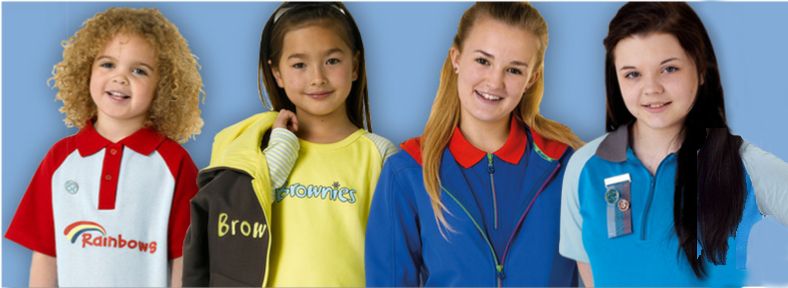
Girlguiding is the UK’s largest girls-only youth organisation, empowering over 400,000 girls and young women across its age groups. First established in 1910, Girlguiding is now over one hundred years old. When the official founder of both the Girl Guides and the Boy Scouts (Robert Baden-Powell) was asked who had started the movement (since his sister Agnes Baden-Powell was closely involved as joint-founder), he declared that the girls had, in fact, ‘started themselves’. Girl-led decision making has remained an important value in the organisation ever since.

In 2010, 50% of women in the UK had been involved in Girlguiding at some stage in their life. This may have been in one of Girlguiding’s four age sections – Rainbows, Brownies, Guides, and Rangers – or as a volunteer or Guider. Most girls who have been involved in Girlguiding say that it has had a massive positive impact on them and their life. Some famous former Girl Guides include Queen Elizabeth II, Princess Margaret, author and philanthropist JK Rowling, Nobel Prize chemist Dorothy Hodgkin, Olympic athlete Dame Kelly Holmes, actress Emma Thompson, Paralympian swimmer Ellie Simmonds, television presenter Clare Balding, actress and television presenter Cat Deeley, politician and former Paralympian medalist Tanni Grey-Thompson, and many others.

Although started in the UK, the Girlguiding movement has been so popular that it’s spread across the globe. The World Association of Girl Guides and Girl Scouts (WAGGGS) now represents ten million girls in 150 different countries. It is the world’s only movement open to every girl and any girl, sharing the same core values as a sisterhood. WAGGGS supports and encourages these girls and young women to reach their full potential as leaders and active citizens of the world. This includes fun, adventure, friendship, and the space to discover their potential.

‘[Through Girlguiding, girls] go to their first ever sleepover, canoe on rivers, learn about body confidence, and lead their own camp. Or sometimes they simply have fun and try new things with friends. Girls take what they do in guiding with them as they grow up. Everything from working in a team, to taking the lead, to speaking out on issues they care about. It helps them develop the skills and confidence to become the young women they want to be. And to make a difference to the world around them.’

Girlguiding UK website

Rainbows

The youngest section of Girlguiding, Rainbows are aged five to seven. It’s a fun and exciting programme all about developing self-confidence, building friendships, learning new things and having fun. Girls get their hands dirty with arts and crafts, get in touch with nature, and play games – it’s all about learning by doing. Rainbows were started in 1987 after pilot groups had been a success. The name Rainbows was chosen to unite the diversity of uniform colours that had developed among the pilot groups, as well as being fun and colourful like the young girls.

Brownies

The largest and most popular section, Brownies are aged seven to ten. It’s about trying new things that teach girls about themselves, their community, and their world. Brownies introduces girls to a world of new opportunities, challenges, and fun. Girls go along to camps, holidays, day trips, and sleepovers. They get together with their friends at regular meetings where they learn new hobbies, get creative, develop skills, and have outdoor adventures. Brownies was set up in 1914 after the younger sisters of Guides wanted to join, but were too young to keep up with the long ‘field days’ of their elder sisters. At first they were called Rosebuds but the girls didn’t like that and demanded a new name! Instead they became Brownies, named after the magical creatures of folk tales that did secret good deeds when no one was looking.

Guides

The original section of Girlguiding and the one from which the other sections have expanded, Guides are aged ten to 14. It’s an exciting and varied programme designed to inspire and challenge girls. Guides take part in lots of exciting activities at regular meetings as well as at special events and on trips away. They have different badges and awards that help them learn new skills and try new challenges, some of which they can do on their own and others they’ll do in groups at their regular unit meetings. Girl Scouts had existed from the earliest days of the Scouting movement in 1907. They were then officially set up as the Girl Guides in 1910, after several hundred girls decided to gatecrash a Boy Scout rally at Crystal Palace in London. Generations of girls since have been glad that they did! They were named Guides after the pioneering Guides of India, by whom Robert Baden-Powell had been greatly impressed.

Rangers

The eldest section, Rangers are aged 14 to 18. It’s all about taking the lead and finding new challenges. As girls prepare for adulthood, Rangers gives them the opportunities to try new things, have fun, travel the world, learn to lead, raise their voice, and give something back to their community, whilst also building an incredible CV through gaining skills and awards. Senior Guides were first set up in 1917 to deal with girls who were outgrowing Guides but didn’t want to leave. They became known as Rangers in 1920 to create a distinct identity for them and to separate them from the Guides, allowing the younger girls the chance to lead for themselves. They were named Rangers because this reflected the desire for them to range wide and explore a larger area than the younger girls could, both physically and intellectually.

‘When you are a Guide, you see the ones [leaders] that are the younger ones, so they’re in their twenties, and you look up to them. “Oh that’s what I would like to be like if I was that age,” and the things that they’re doing seem so fun when you’re that age because that’s what you want to be able to do yourself. But I think that also, with the older ones [leaders] it’s a mother figure or sometimes even a grandma figure, and it’s just a different group of people to speak to that aren’t connected to your school and they aren’t your family. And I think that when you’re going through all those things you feel as a teenage girl, having someone that’s completely unconnected to the rest of your life to speak to about those things – especially in Guides some of the younger leaders, they’re only actually three or four years older than you… and they can kind of influence you without them appearing to give you advice because you look at them almost as a friend.’

Cat Talbot