Last week I gave a review of Emily Post’s 1922 book Etiquette: in Society, in Business, in Politics, and at Home. In that, I shared a number of quotations. However, there was one passage that was too long to include with the review. I really like this passage and so thought it merited a blog article of its own. It describes how Emily Post believed ‘the perfect guest’ should behave. I find it aspirational because it is the type of lady I want to become and the character I seek to cultivate. She is warm, caring, selfless, charming, creative, ready to be playful but also dignified, above all motivated by love and so loved in response. As we grow towards becoming better women, I think the world would be a better place if we tried to include some of these characteristics.
‘The perfect guest not only tries to wear becoming clothes but tries to put on an equally becoming mental attitude. No one is ever asked out very much who is in the habit of telling people all the misfortunes and ailments she has experienced or witnessed, though the perfect guest listens with apparent sympathy to every one else’s. Another attribute of the perfect guest is never to keep people waiting. She is always ready for anything—or nothing. If a plan is made to picnic, she likes picnics above everything and proves her liking by enthusiastically making the sandwiches or the salad dressing or whatever she thinks she makes best. If, on the other hand, no one seems to want to do anything, the perfect guest has always a book she is absorbed in, or a piece of sewing she is engrossed with, or else beyond everything she would love to sit in an easy chair and do nothing.
She never for one moment thinks of herself, but of the other people she is thrown with. She is a person of sympathy always, and instantaneous discernment. She is good tempered no matter what happens, and makes the most of everything as it comes. At games she is a good loser, and a quiet winner. She has a pleasant word, an amusing story, and agreeable comment for most occasions, but she is neither gushing nor fulsome. She has merely acquired a habit, born of many years of arduous practise, of turning everything that looks like a dark cloud as quickly as possible for the glimmer of a silver lining.
She is as sympathetic to children as to older people; she cuts out wonderful paper dolls and soldier hats, always leisurely and easily as though it cost neither time nor effort. She knows a hundred stories or games, every baby and every dog goes to her on sight, not because she has any especial talent, except that one she has cultivated, the talent of interest in everyone and everything except herself. Few people know that there is such a talent or that it can be cultivated.
She has more than mere beauty; she has infinite charm, and she is so well born that she is charming to everyone. Her manner to a duke who happens to be staying in the house is not a bit more courteous than her manner to the kitchen-maid whom she chances to meet in the kitchen gardens whither she has gone with the children to see the new kittens; as though new kittens were the apex of all delectability!
She always calls the servants by name; always says “How do you do” when she arrives, “Good morning” while there, and “Good-by” when she leaves. And do they presume because of her “familiarity” when she remembers to ask after the parlor-maid’s mother and the butler’s baby? They wait on her as they wait on no one else who comes to the house—neither the Senator nor the Governor, nor his Grace of Overthere!
This ideal guest is an equally ideal hostess; the principle of both is the same. A ready smile, a quick sympathy, a happy outlook, consideration for others, tenderness toward everything that is young or helpless, and forgetfulness of self, which is not far from the ideal of womankind.’
Emily Post, Etiquette: in Society, in Business, in Politics, and at Home (1922)
‘Manners are made up of trivialities of deportment, which can be easily learnt if one does not happen to know them. Manner is personality, the outward manifestation of one’s innate character and attitude towards life.’
Emily Post
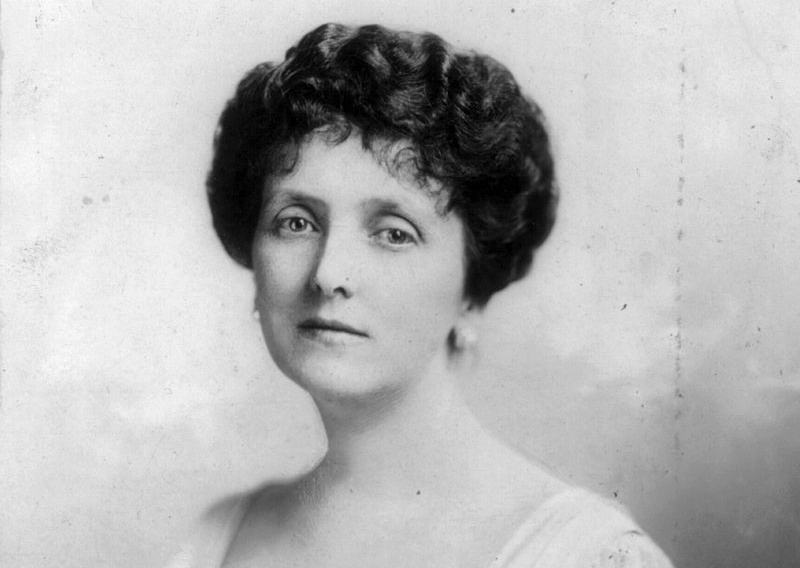
Emily Post first published her book Etiquette: in Society, in Business, in Politics, and at Home in New York in 1922, the era of the ‘roaring twenties’. She was an American lady, born in 1872 and living until 1960. Emily Post is occasionally heralded as the ‘mistress of manners’ in America, due to the popularity of her book. The 1920s were a lively time of modernity, during which progress seeped into the established traditions. This can be felt in the contrast with Florence Hartley’s Victorian etiquette book – although many of the conventions were still the same, there is an underlying energy along with references to a new, freely social youth. A large part of Emily Post’s popularity was that her book fed into the American dream of being able to get ahead. Etiquette is presented as something anyone can learn if they so desire.
Emily Post’s Etiquette: in Society, in Business, in Politics, and at Home is a sizeable volume. The free audio book (which I’ve linked below) adds to a total of over 20 hours long. It was intended to be a complete guide for both ladies and gentlemen of the time, and has much advice that remains relevant today, even whilst other parts are of more of a historical interest. Emily Post covers a range of topics including: greetings, conversation, visits, dinners, balls and dances, debutantes, weddings, Christenings, funerals, hospitality, letter writing, business, dress, teaching children etiquette, everyday manners, and travelling.
A recurring group of fictional characters – or pseudonymous characters at least – play out situations throughout the book, initiating readers into their sophisticated society. Aspects of their existence are now out of touch, such as the assumption of employing at least one servant and the formality of introductions. Despite that, the principles underpinning good manners are enduring. Emily Post herself notes a relaxing of certain formalities in her own time. She writes a lot about of etiquette of various social occasions, the organisation of weddings, and letter writing, ending on an optimistic note about what she hopes the future of America to be. Since it’s freely available online, I’ve shared below a number of quotations advising on different topics.
On Conversation
‘People who talk too easily are apt to talk too much, and at times imprudently, and those with good imaginations are unreliable in their statements. On the other hand, the “man of silence” who never speaks unless he has something worth while to say, is apt to wear well among his intimates, but is not likely to add much to the gaiety of the party.’
Emily Post
‘The charming talker is neither more nor less than a fisherman – or fisherwoman rather, since in America women make more effort to be agreeable than men do. Sitting next to a stranger, she wonders which “fly” she had better choose to interest him. She tries one topic – not much of a nibble – so she tries another topic, or perhaps a third, before he rises to the bait.’
Emily Post
On Social Interest
‘Many things are of interest when briefly told and for the first time; nothing interests when too long dwelt upon; and little interests when told a second time.’
Emily Post
‘On the other hand, to be bored is a bad habit and one only too easy to fall into. As a matter of fact, it is impossible, almost, to meet anyone who has not something of interest to tell you if you are but clever enough yourself to find out what it is.’
Emily Post
On Hospitality
‘There never lived a lady of great cultivation and charm whose home – whether a palace, a farm cottage, or a tiny apartment – did not reflect the charm of its owner.’
Emily Post
‘Some people have the gift of hospitality. Others, whose intentions are just as kind and whose houses are perfection in luxury of appointments, seem to petrify at every approach. Such people appearing at a picnic colour the entire scene with the blue light of their austerity. Such are usually not masters but slaves of etiquette. Their chief concern is whether this is correct or whether that is properly done, or is this or that such a one as they care to know. They seem… to be anxiously asking themselves, have I failed today or have I not? Introspective people who are fearful of others and fearful of themselves are never successful hosts or hostesses.’
Emily Post
‘It is still unforgivable to eat a man’s bread and remain his enemy. It is unforgivable to criticise your host or in his presence to criticise his friends. It is unforgivable to be rude to anyone under your own roof or under the roof of a friend. If you must quarrel with your enemy, seek public or neutral ground, since quarrels and hospitality must never be mingled.’
Emily Post
On Politeness
‘To be courteously polite and yet keep one’s walls up is a thing every thoroughbred person knows how to do, and a thing everyone who is trying to become such must learn how to do. A rule can’t be given because there isn’t any… a well-bred person always lives within the rules of his personal reserve. A vulgarian has no walls, or at least none that do not collapse at the slightest touch. But those who think they appear superior by being rude to others, whom fortune has placed below them, might as well, did they but know it, shout their own unexalted origin to the world at large since by no other method could it be more widely published.’
Emily Post
On Dining
‘To give a perfect dinner of ceremony is the supreme accomplishment of a hostess.’
Emily Post
‘The turning of the table is accomplished by the hostess, who merely turns from the gentleman on her left probably, with whom she has been talking through the soup and the fish course, to the one on her right. As she turns, the lady to whom the gentleman on the right has been talking turns to the gentleman further on, and in a moment everyone at the table is talking to a new neighbour.’
Emily Post
‘One inextricable rule of etiquette is that you must talk to your next-door neighbour at dinner table. You must. That is all there is about it. Even if you are placed next to someone with whom you have had a bitter quarrel, consideration for your hostess, who would be distressed if she knew you had been put in a disagreeable place, and further consideration for the rest of the table which is otherwise blocked, exact that you make no outward sign of your repugnance and that you make a pretence, at least for a little while, of talking together.’
Emily Post
On Balls
‘To refuse to dance with one man and then immediately dance with another, is an open affront to the first one, excusable only if he was intoxicated or otherwise actually offensive so that the affront was both intentional and justifiable. But under ordinary circumstances, if she is dancing she must dance with everyone who asks her. If she is not dancing, she must not make exceptions.’
Emily Post
‘It is always the privilege of the girl to stop dancing. The man is suppose to dance on and on until she or the music stops.’
Emily Post
On Popularity
‘The great ballroom success, first and foremost, dances well. Almost always, she is pretty… Let us suppose therefore that she dances well, that she has a certain degree of looks, that she is fairly intelligent. The next most important thing, after dancing well, is to be unafraid and look as though she were having a good time… There is one thing that every girl who would really be popular should learn, in fact she must learn: self-unconsciousness. The best advice might be to follow somewhat the precepts of mental science, and make herself believe that a good time exists in her own mind. If she can become possessed with the idea that she is having a good time, and look as though she were, the psychological effect is astonishing.’
Emily Post
‘A gift of more value than beauty is charm, which in a measure is another word for sympathy or the power to put yourself in the place of others, to be interested in whatever interests them so as to be pleasing to them if possible, but not to occupy your thoughts and futilely wondering what they may think about you. Would you know the secret of popularity? It is unconsciousness of self, altruistic interest, and inward kindliness outwardly expressed in good manners.’
Emily Post
‘If you know anyone who is always in demand, not only for dinners, but for trips on private cars and yachts, and long visits in country houses, you may be very sure of one thing: the popular person is first of all unselfish or else extremely gifted; very often both.’
Emily Post
On Standards
‘This is a rather noteworthy fact: all people of good position talk alike, behave alike, and live alike. Ill-mannered servants, incorrect liveries or services, sloppily dished food, carelessness in any of the details that to well-bred people constitute the decencies of living, are no more tolerated in the smallest cottage than in the house.’
Emily Post
‘Well-bred people never deteriorate in manner. Their behaviour is precisely the same whether at Great Estates or in camp. A gentleman may be in his shirt sleeves actually, but he never gets into shirt sleeves mentally – he has no inclination to.’
Emily Post
On Being a Lady
‘The instincts of a lady are much the same as those of a gentleman. She is equally punctilious about her debts, equally averse to pressing her advantage; especially if her adversary is helpless or poor.’
Emily Post
‘All thoroughbred women, and men, are considerate of others less fortunately placed, especially of those in their employ. One of the tests by which to distinguish between the woman of breeding and the woman merely of wealth, is to notice the way she speaks to dependants… When you see a woman in silks and sables and diamonds speak to a little errand girl or a footman or a scullery maid as though they were the dirt under her feet, you may be sure of one thing; she hasn’t come a very long way from the ground herself.’
Emily Post
On Everyday Manners
‘Just as no chain is stronger than its weakest link, no manners can be expected to stand a strain beyond their daily test at home. Those who are used to losing their temper in the bosom of their family will sooner or later lose it in public. Families which exert neither courtesy nor charm when alone, can no more deceive other people into believing that either attribute belongs to them than they could hope to make painted faces look like “real” complexions.’
Emily Post
‘In the present day of rush and hurry, there is little time for “home” example. To the over-busy or gaily fashionable, “home” might as well be a railroad station, and members of a family passengers who see each other only for a few hurried minutes before taking trains in opposite directions. The days are gone when the family sat in the evening around the fire, or a “table with a lamp,” when it was customary to read aloud or to talk. Few people “talk well” in these days; fewer read aloud, and fewer still endure listening to any book literally word by word.’
Emily Post
On Travelling
‘To do nothing that can either annoy or offend the sensibilities of others, sums up the principal rules for conduct under all circumstances—whether staying at home or travelling. But in order to do nothing that can annoy or give offence, it is necessary for us to consider the point of view of those with whom we come in contact; and in travelling abroad it is necessary to know something of foreign customs which affect the foreign point of view.’
Emily Post
Learn More
Chapter timestamps: Introduction: Manners and Morals – 00:00:00 Chapter 1: What is Best Society? – 00:16:54 Chapter 2: Introductions – 00:23:03 Chapter 3: Greetings – 00:53:27 Chapter 4: Salutations of Courtesy – 01:01:23 Chapter 5: On the Street and in Public – 01:12:01 Chapter 6: At Public Gatherings – 01:28:41 Chapter 7: Conversation – 01:53:47 Chapter 8: Words, Phrases, and Pronunciation – 02:15:33 Chapter 9: One’s Position in the Community – 02:32:32 Chapter 10: Cards and Visits – 02:49:23 Chapter 11: Invitations, Acceptances and Regrets 03:42:50 Chapter 12, Part 1: The Well-Appointed House – 04:14:54 Chapter 12, Part 2: The Well-Appointed House – 04:39:55 Chapter 12, Part 3: The Well-Appointed House – 05:06:31 Chapter 13: Teas and Other Afternoon Parties – 05:31:25 Chapter 14, Part 1: Formal Dinners – 05:55:01 Chapter 14, Part 2: Formal Dinners – 06:17:13 Chapter 14, Part 3: Formal Dinners – 06:45:32 Chapter 14, Part 4: Formal Dinners – 07:05:17 Chapter 14, Part 5: Formal Dinners – 07:27:11 Chapter 15: Dinner-Giving with Limited Equipment – 07:49:12 Chapter 16: Luncheons, Breakfasts and Suppers – 08:01:56 Chapter 17, Part 1: Balls and Dances – 08:27:40 Chapter 17, Part 2: Balls and Dances – 08:53:12 Chapter 18: The Debutante – 09:20:52 Chapter 19: The Chaperon and Other Conventions – 09:44:05
Chapter timestamps: Chapter 20: Engagements – 00:00:00 Chapter 21, Part 1: First Preparations before a Wedding – 00:27:15 Chapter 21, Part 2: First Preparations before a Wedding – 00:52:38 Chapter 21, Part 3: First Preparations before a Wedding – 01:20:18 Chapter 22, Part 1: The Day of the Wedding – 01:39:49 Chapter 22, Part 2: The Day of the Wedding – 02:03:12 Chapter 22, Part 3: The Day of the Wedding – 02:26:37 Chapter 23: Christenings – 02:45:18 Chapter 24: Funerals – 02:58:25 Chapter 25, Part 1: The Country House and Its Hospitality – 03:52:50 Chapter 25, Part 2: The Country House and Its Hospitality – 04:31:18 Chapter 26: The House Party in Camp – 05:07:04 Chapter 27, Part 1: Notes and Shorter Letters – 05:24:21 Chapter 27, Part 2: Notes and Shorter Letters – 05:41:44 Chapter 27, Part 3: Notes and Shorter Letters – 05:57:16 Chapter 27, Part 4: Notes and Shorter Letters – 06:16:08 Chapter 27, Part 5: Notes and Shorter Letters – 06:35:32 Chapter 28: Longer Letters – 06:51:48 Chapter 29: The Fundamentals of Good Behaviour – 07:17:37 Chapter 30: Clubs and Club Etiquette – 07:30:10 Chapter 31: Games and Sports – 08:03:02 Chapter 32: Etiquette in Business and Politics – 08:16:49 Chapter 33, Part 1: Dress – 08:37:11 Chapter 33, Part 2: Dress – 08:58:18 Chapter 34: The Clothes of a Gentleman – 09:23:06 Chapter 35: The Kindergarten of Etiquette – 09:42:07 Chapter 36: Every-Day Manners at Home – 10:14:31 Chapter 37, Part 1: Travelling At Home and Abroad – 10:30:21 Chapter 37, Part 2: Travelling At Home and Abroad – 10:58:38 Chapter 38: The Growth of Good Taste in America – 11:32:14

 Feminine Finishing School