Building Friendships, Community, & Family

‘When two people unite, they become a family. When families unite, they become a clan. When clans unite, they become a tribe. When tribes unite, they become a nation. And when nations unite… well, that never really happens, does it?’

Anonymous (a.k.a. I can’t remember where I read it!)

Marriages, families, clans, tribes, nations, societies, communities, friendships, human relationships… all these are building blocks and not so different from each other. This is something I’ve been pondering lately. What is community and what makes a good community? How can we create good community, and how does that relate to all the other levels of human relationships?

The largest grouping of people that we usually deal with or belong to is society, which tends to correspond with nation state – flawed though that division may be. When we interact face-to-face, in person with someone, we are both in the same land and so interact in a certain society, even if we may be from differing countries. Groupings larger than society are too big to deal with in this little blog post anyway, so let’s draw the line there for now. Though maybe in this disembodied realm of the internet, language takes on the role that land once used to have?

Society (country) is made up of communities, and those communities (towns or villages) in turn are made up of families (households). As children we learn in our family how to be part of community and how to contribute to society. However, as we grow up and leave home, we learn in community (our friendship groups) how to create connections and the type of environment we’ll one day want to take into our own families, if or when we marry and have children ourselves. It’s a cycle constantly feeding into itself. Community comes from family, and family comes from community.

It takes a village to raise a child, yet people are people and sometimes community can be difficult. Nothing valuable is ever easy and, for all the heartache and tears it may cause, we must never give up trying to build human connections. We have to live and learn and try again. None of us are meant to exist in isolation – to quote another often-repeated saying: ‘no man is an island’. We have to learn to let down the drawbridge of our souls.

I like the quotation I shared at the top of this blog post because it links different levels of human relationship and shows how they grow out of each other – even though its end is rather cynical. What do those progressive levels mean? People are our personal relationships and individual connections, such as marriage and one-to-one friendships. Family means the nuclear family of parents and children, or a household. Clan is our extended family of grandparents, aunts, uncles, cousins, extended cousins, as well as our close friends. Clans have shared kinship from common ancestors, but aren’t necessarily as close-knit as a nuclear family. Tribe is our local community, neighbourhood, and (if we are Christian) small-c church as in our local church. Unlike clans, tribe members are not all related, but live alongside each other within a shared culture and commonly accepted way of life.

Nation is the big one. It’s arguably the largest structure that society organises itself into, sharing culture, governance, and laws. Big-C Church, as in the universal church across all countries and denominations, stands at the same level as nation in terms of being a society. All Christians who seek after God recognise His culture of loving kindness and His righteous laws, and are therefore united within the kingdom of God. The universal Church links to a society that transcends nation or land. At least, it should do – but people being people tend to mess up and cause division or sometimes even cruelty. The more people you get, the more chance someone will fall short. That doesn’t mean we should give up or totally dismiss idealistic goals; we simply need to be realistic in our expectations and have grace for one another. The truth is we all fall short – and that’s why Jesus forgiving our sins on the cross unites us.

‘The word “natio” means “birth” because a person is born into his nation and that cannot be changed. By virtue of one’s birth one owes allegiance to the ancestral spirits, who one will have to honour throughout life. Before Christianity, conversion was inconceivable. Each nation worshipped its own ancestral gods forever – the Romans, the Celts, the Jews, the Egyptians, the Britons, the Belgae, the Greeks – each nation had its own temples and shrines where its gods were worshipped.’

Jan Knappert

These days we tend to forget just how radical Christianity was in bringing people together. It was the first religion to welcome all people, rather than belonging to a single ethnic and cultural group. Equally, we need to remember that the reason there are so many letters in the New Testament was because those early churches needed help in resolving their differences and seeking Christ together. People were people, even then. God called us not just to follow Him but to be the Church and be with ‘one another’. Perhaps this blog post has been a bit of a ramble, but I hope it gives you some food for thought. The process of writing it has certainly given me some things to think about.

The Perfect Guest According to Emily Post

Last week I gave a review of Emily Post’s 1922 book Etiquette: in Society, in Business, in Politics, and at Home. In that, I shared a number of quotations. However, there was one passage that was too long to include with the review. I really like this passage and so thought it merited a blog article of its own. It describes how Emily Post believed ‘the perfect guest’ should behave. I find it aspirational because it is the type of lady I want to become and the character I seek to cultivate. She is warm, caring, selfless, charming, creative, ready to be playful but also dignified, above all motivated by love and so loved in response. As we grow towards becoming better women, I think the world would be a better place if we tried to include some of these characteristics.

‘The perfect guest not only tries to wear becoming clothes but tries to put on an equally becoming mental attitude. No one is ever asked out very much who is in the habit of telling people all the misfortunes and ailments she has experienced or witnessed, though the perfect guest listens with apparent sympathy to every one else’s. Another attribute of the perfect guest is never to keep people waiting. She is always ready for anything—or nothing. If a plan is made to picnic, she likes picnics above everything and proves her liking by enthusiastically making the sandwiches or the salad dressing or whatever she thinks she makes best. If, on the other hand, no one seems to want to do anything, the perfect guest has always a book she is absorbed in, or a piece of sewing she is engrossed with, or else beyond everything she would love to sit in an easy chair and do nothing.

She never for one moment thinks of herself, but of the other people she is thrown with. She is a person of sympathy always, and instantaneous discernment. She is good tempered no matter what happens, and makes the most of everything as it comes. At games she is a good loser, and a quiet winner. She has a pleasant word, an amusing story, and agreeable comment for most occasions, but she is neither gushing nor fulsome. She has merely acquired a habit, born of many years of arduous practise, of turning everything that looks like a dark cloud as quickly as possible for the glimmer of a silver lining.

She is as sympathetic to children as to older people; she cuts out wonderful paper dolls and soldier hats, always leisurely and easily as though it cost neither time nor effort. She knows a hundred stories or games, every baby and every dog goes to her on sight, not because she has any especial talent, except that one she has cultivated, the talent of interest in everyone and everything except herself. Few people know that there is such a talent or that it can be cultivated.

She has more than mere beauty; she has infinite charm, and she is so well born that she is charming to everyone. Her manner to a duke who happens to be staying in the house is not a bit more courteous than her manner to the kitchen-maid whom she chances to meet in the kitchen gardens whither she has gone with the children to see the new kittens; as though new kittens were the apex of all delectability!

She always calls the servants by name; always says “How do you do” when she arrives, “Good morning” while there, and “Good-by” when she leaves. And do they presume because of her “familiarity” when she remembers to ask after the parlor-maid’s mother and the butler’s baby? They wait on her as they wait on no one else who comes to the house—neither the Senator nor the Governor, nor his Grace of Overthere!

This ideal guest is an equally ideal hostess; the principle of both is the same. A ready smile, a quick sympathy, a happy outlook, consideration for others, tenderness toward everything that is young or helpless, and forgetfulness of self, which is not far from the ideal of womankind.’

Emily Post, Etiquette: in Society, in Business, in Politics, and at Home (1922)

Book Review: Etiquette in Society, in Business, in Politics, & at Home

‘Manners are made up of trivialities of deportment, which can be easily learnt if one does not happen to know them. Manner is personality, the outward manifestation of one’s innate character and attitude towards life.’

Emily Post

Emily Post first published her book Etiquette: in Society, in Business, in Politics, and at Home in New York in 1922, the era of the ‘roaring twenties’. She was an American lady, born in 1872 and living until 1960. Emily Post is occasionally heralded as the ‘mistress of manners’ in America, due to the popularity of her book. The 1920s were a lively time of modernity, during which progress seeped into the established traditions. This can be felt in the contrast with Florence Hartley’s Victorian etiquette book – although many of the conventions were still the same, there is an underlying energy along with references to a new, freely social youth. A large part of Emily Post’s popularity was that her book fed into the American dream of being able to get ahead. Etiquette is presented as something anyone can learn if they so desire.

Emily Post’s Etiquette: in Society, in Business, in Politics, and at Home is a sizeable volume. The free audio book (which I’ve linked below) adds to a total of over 20 hours long. It was intended to be a complete guide for both ladies and gentlemen of the time, and has much advice that remains relevant today, even whilst other parts are of more of a historical interest. Emily Post covers a range of topics including: greetings, conversation, visits, dinners, balls and dances, debutantes, weddings, Christenings, funerals, hospitality, letter writing, business, dress, teaching children etiquette, everyday manners, and travelling.

A recurring group of fictional characters – or pseudonymous characters at least – play out situations throughout the book, initiating readers into their sophisticated society. Aspects of their existence are now out of touch, such as the assumption of employing at least one servant and the formality of introductions. Despite that, the principles underpinning good manners are enduring. Emily Post herself notes a relaxing of certain formalities in her own time. She writes a lot about of etiquette of various social occasions, the organisation of weddings, and letter writing, ending on an optimistic note about what she hopes the future of America to be. Since it’s freely available online, I’ve shared below a number of quotations advising on different topics.

On Conversation

‘People who talk too easily are apt to talk too much, and at times imprudently, and those with good imaginations are unreliable in their statements. On the other hand, the “man of silence” who never speaks unless he has something worth while to say, is apt to wear well among his intimates, but is not likely to add much to the gaiety of the party.’

Emily Post

‘The charming talker is neither more nor less than a fisherman – or fisherwoman rather, since in America women make more effort to be agreeable than men do. Sitting next to a stranger, she wonders which “fly” she had better choose to interest him. She tries one topic – not much of a nibble – so she tries another topic, or perhaps a third, before he rises to the bait.’

Emily Post

On Social Interest

‘Many things are of interest when briefly told and for the first time; nothing interests when too long dwelt upon; and little interests when told a second time.’

Emily Post

‘On the other hand, to be bored is a bad habit and one only too easy to fall into. As a matter of fact, it is impossible, almost, to meet anyone who has not something of interest to tell you if you are but clever enough yourself to find out what it is.’

Emily Post

On Hospitality

‘There never lived a lady of great cultivation and charm whose home – whether a palace, a farm cottage, or a tiny apartment – did not reflect the charm of its owner.’

Emily Post

‘Some people have the gift of hospitality. Others, whose intentions are just as kind and whose houses are perfection in luxury of appointments, seem to petrify at every approach. Such people appearing at a picnic colour the entire scene with the blue light of their austerity. Such are usually not masters but slaves of etiquette. Their chief concern is whether this is correct or whether that is properly done, or is this or that such a one as they care to know. They seem… to be anxiously asking themselves, have I failed today or have I not? Introspective people who are fearful of others and fearful of themselves are never successful hosts or hostesses.’

Emily Post

‘It is still unforgivable to eat a man’s bread and remain his enemy. It is unforgivable to criticise your host or in his presence to criticise his friends. It is unforgivable to be rude to anyone under your own roof or under the roof of a friend. If you must quarrel with your enemy, seek public or neutral ground, since quarrels and hospitality must never be mingled.’

Emily Post

On Politeness

‘To be courteously polite and yet keep one’s walls up is a thing every thoroughbred person knows how to do, and a thing everyone who is trying to become such must learn how to do. A rule can’t be given because there isn’t any… a well-bred person always lives within the rules of his personal reserve. A vulgarian has no walls, or at least none that do not collapse at the slightest touch. But those who think they appear superior by being rude to others, whom fortune has placed below them, might as well, did they but know it, shout their own unexalted origin to the world at large since by no other method could it be more widely published.’

Emily Post

On Dining

‘To give a perfect dinner of ceremony is the supreme accomplishment of a hostess.’

Emily Post

‘The turning of the table is accomplished by the hostess, who merely turns from the gentleman on her left probably, with whom she has been talking through the soup and the fish course, to the one on her right. As she turns, the lady to whom the gentleman on the right has been talking turns to the gentleman further on, and in a moment everyone at the table is talking to a new neighbour.’

Emily Post

‘One inextricable rule of etiquette is that you must talk to your next-door neighbour at dinner table. You must. That is all there is about it. Even if you are placed next to someone with whom you have had a bitter quarrel, consideration for your hostess, who would be distressed if she knew you had been put in a disagreeable place, and further consideration for the rest of the table which is otherwise blocked, exact that you make no outward sign of your repugnance and that you make a pretence, at least for a little while, of talking together.’

Emily Post

On Balls

‘To refuse to dance with one man and then immediately dance with another, is an open affront to the first one, excusable only if he was intoxicated or otherwise actually offensive so that the affront was both intentional and justifiable. But under ordinary circumstances, if she is dancing she must dance with everyone who asks her. If she is not dancing, she must not make exceptions.’

Emily Post

‘It is always the privilege of the girl to stop dancing. The man is suppose to dance on and on until she or the music stops.’

Emily Post

On Popularity

‘The great ballroom success, first and foremost, dances well. Almost always, she is pretty… Let us suppose therefore that she dances well, that she has a certain degree of looks, that she is fairly intelligent. The next most important thing, after dancing well, is to be unafraid and look as though she were having a good time… There is one thing that every girl who would really be popular should learn, in fact she must learn: self-unconsciousness. The best advice might be to follow somewhat the precepts of mental science, and make herself believe that a good time exists in her own mind. If she can become possessed with the idea that she is having a good time, and look as though she were, the psychological effect is astonishing.’

Emily Post

‘A gift of more value than beauty is charm, which in a measure is another word for sympathy or the power to put yourself in the place of others, to be interested in whatever interests them so as to be pleasing to them if possible, but not to occupy your thoughts and futilely wondering what they may think about you. Would you know the secret of popularity? It is unconsciousness of self, altruistic interest, and inward kindliness outwardly expressed in good manners.’

Emily Post

‘If you know anyone who is always in demand, not only for dinners, but for trips on private cars and yachts, and long visits in country houses, you may be very sure of one thing: the popular person is first of all unselfish or else extremely gifted; very often both.’

Emily Post

On Standards

‘This is a rather noteworthy fact: all people of good position talk alike, behave alike, and live alike. Ill-mannered servants, incorrect liveries or services, sloppily dished food, carelessness in any of the details that to well-bred people constitute the decencies of living, are no more tolerated in the smallest cottage than in the house.’

Emily Post

‘Well-bred people never deteriorate in manner. Their behaviour is precisely the same whether at Great Estates or in camp. A gentleman may be in his shirt sleeves actually, but he never gets into shirt sleeves mentally – he has no inclination to.’

Emily Post

On Being a Lady

‘The instincts of a lady are much the same as those of a gentleman. She is equally punctilious about her debts, equally averse to pressing her advantage; especially if her adversary is helpless or poor.’

Emily Post

‘All thoroughbred women, and men, are considerate of others less fortunately placed, especially of those in their employ. One of the tests by which to distinguish between the woman of breeding and the woman merely of wealth, is to notice the way she speaks to dependants… When you see a woman in silks and sables and diamonds speak to a little errand girl or a footman or a scullery maid as though they were the dirt under her feet, you may be sure of one thing; she hasn’t come a very long way from the ground herself.’

Emily Post

On Everyday Manners

‘Just as no chain is stronger than its weakest link, no manners can be expected to stand a strain beyond their daily test at home. Those who are used to losing their temper in the bosom of their family will sooner or later lose it in public. Families which exert neither courtesy nor charm when alone, can no more deceive other people into believing that either attribute belongs to them than they could hope to make painted faces look like “real” complexions.’

Emily Post

‘In the present day of rush and hurry, there is little time for “home” example. To the over-busy or gaily fashionable, “home” might as well be a railroad station, and members of a family passengers who see each other only for a few hurried minutes before taking trains in opposite directions. The days are gone when the family sat in the evening around the fire, or a “table with a lamp,” when it was customary to read aloud or to talk. Few people “talk well” in these days; fewer read aloud, and fewer still endure listening to any book literally word by word.’

Emily Post

On Travelling

‘To do nothing that can either annoy or offend the sensibilities of others, sums up the principal rules for conduct under all circumstances—whether staying at home or travelling. But in order to do nothing that can annoy or give offence, it is necessary for us to consider the point of view of those with whom we come in contact; and in travelling abroad it is necessary to know something of foreign customs which affect the foreign point of view.’

Emily Post

Learn More

Chapter timestamps:
Introduction: Manners and Morals – 00:00:00
Chapter 1: What is Best Society? – 00:16:54
Chapter 2: Introductions – 00:23:03
Chapter 3: Greetings – 00:53:27
Chapter 4: Salutations of Courtesy – 01:01:23
Chapter 5: On the Street and in Public – 01:12:01
Chapter 6: At Public Gatherings – 01:28:41
Chapter 7: Conversation – 01:53:47
Chapter 8: Words, Phrases, and Pronunciation – 02:15:33
Chapter 9: One’s Position in the Community – 02:32:32
Chapter 10: Cards and Visits – 02:49:23
Chapter 11: Invitations, Acceptances and Regrets 03:42:50
Chapter 12, Part 1: The Well-Appointed House – 04:14:54
Chapter 12, Part 2: The Well-Appointed House – 04:39:55
Chapter 12, Part 3: The Well-Appointed House – 05:06:31
Chapter 13: Teas and Other Afternoon Parties – 05:31:25
Chapter 14, Part 1: Formal Dinners – 05:55:01
Chapter 14, Part 2: Formal Dinners – 06:17:13
Chapter 14, Part 3: Formal Dinners – 06:45:32
Chapter 14, Part 4: Formal Dinners – 07:05:17
Chapter 14, Part 5: Formal Dinners – 07:27:11
Chapter 15: Dinner-Giving with Limited Equipment – 07:49:12
Chapter 16: Luncheons, Breakfasts and Suppers – 08:01:56
Chapter 17, Part 1: Balls and Dances – 08:27:40
Chapter 17, Part 2: Balls and Dances – 08:53:12
Chapter 18: The Debutante – 09:20:52
Chapter 19: The Chaperon and Other Conventions – 09:44:05
Chapter timestamps:
Chapter 20: Engagements – 00:00:00
Chapter 21, Part 1: First Preparations before a Wedding – 00:27:15
Chapter 21, Part 2: First Preparations before a Wedding – 00:52:38
Chapter 21, Part 3: First Preparations before a Wedding – 01:20:18
Chapter 22, Part 1: The Day of the Wedding – 01:39:49
Chapter 22, Part 2: The Day of the Wedding – 02:03:12
Chapter 22, Part 3: The Day of the Wedding – 02:26:37
Chapter 23: Christenings – 02:45:18
Chapter 24: Funerals – 02:58:25
Chapter 25, Part 1: The Country House and Its Hospitality – 03:52:50
Chapter 25, Part 2: The Country House and Its Hospitality – 04:31:18
Chapter 26: The House Party in Camp – 05:07:04
Chapter 27, Part 1: Notes and Shorter Letters – 05:24:21
Chapter 27, Part 2: Notes and Shorter Letters – 05:41:44
Chapter 27, Part 3: Notes and Shorter Letters – 05:57:16
Chapter 27, Part 4: Notes and Shorter Letters – 06:16:08
Chapter 27, Part 5: Notes and Shorter Letters – 06:35:32
Chapter 28: Longer Letters – 06:51:48
Chapter 29: The Fundamentals of Good Behaviour – 07:17:37
Chapter 30: Clubs and Club Etiquette – 07:30:10
Chapter 31: Games and Sports – 08:03:02
Chapter 32: Etiquette in Business and Politics – 08:16:49
Chapter 33, Part 1: Dress – 08:37:11
Chapter 33, Part 2: Dress – 08:58:18
Chapter 34: The Clothes of a Gentleman – 09:23:06
Chapter 35: The Kindergarten of Etiquette – 09:42:07
Chapter 36: Every-Day Manners at Home – 10:14:31
Chapter 37, Part 1: Travelling At Home and Abroad – 10:30:21
Chapter 37, Part 2: Travelling At Home and Abroad – 10:58:38
Chapter 38: The Growth of Good Taste in America – 11:32:14

Book Review: The Ladies’ Book of Etiquette & Manual of Politeness

‘Politeness is goodness of heart put into daily practice.’

Florence Hartley

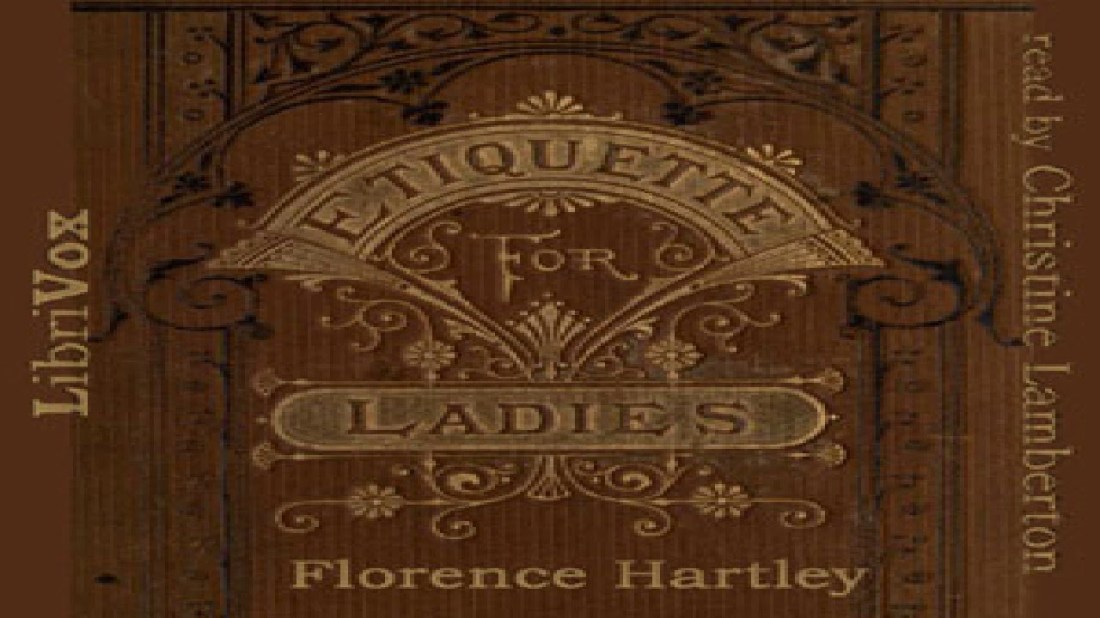
The Ladies’ Book of Etiquette, and Manual of Politeness. A Complete Hand Book for the Use of the Lady in Polite Society was written by Florence Hartley, an American lady of the mid-Victorian period. It was first published in Boston in 1860, and is now freely available online to the public. An equivalent book of etiquette for gentlemen was published in the same year by a Cecil B Hartley, who I suppose to have been some male relation of Florence Hartley. Besides etiquette, Florence Hartley also wrote on needlework and was an advocate for women’s health. Her books received favourable reviews during her own time, but little is known about her life.

Since it is Victorian, some parts of Florence Hartley’s book are naturally dated – for instance the constant requirement for an escort or chaperone, the suspicion of servants, the formality of bowing in greeting, and the abundance of socialising hours available to the Victorian lady of leisure. Despite this, there’s much advice that is still relevant today. The underlying principles of good manners are universal, carrying across into all cultural contexts, even though the specific behaviour of etiquette manifests differently. Florence Hartley’s discussion of ‘true Christian politeness’ for ladies explores a range of topics including: conversation, dress, travelling, hospitality, visiting, letter writing, deportment, conduct in church, social events, accomplishments, servants, engagements, and weddings.

I appreciate quirky old books, and so personally find the historic material as interesting as the etiquette still applicable today. For Florence Hartley, etiquette seems to be most exemplified in hospitality and therefore this is a large focus in the book, with information for both hostess and guest. She included a considerable chapter on accomplishments, where in addition to the usual accomplishments she promotes conversational skills, horse riding, and gives detailed instructions on needlework. Besides working on such accomplishments, ladies were advised to walk four or five miles a day, and the visiting hours of Victorian society tended to be between 11am and 3pm. Since The Ladies’ Book of Etiquette, and Manual of Politeness is no longer under copyright restrictions, I have taken advantage of that by sharing a liberal selection of quotations below, along with a link to the free audiobook.

On Politeness & Etiquette

‘To be truly polite, remember, you must be polite at all times and under all circumstances.’

Florence Hartley

‘True politeness will be found – its basis in the human heart – the same in all these varied scenes and situations, but the outward forms of etiquette will vary everywhere. Even in the same scene, time will alter every form and render the exquisite polish of last year, obsolete rudeness next year.’

Florence Hartley

‘If you neglect these little details at home, and in private, they will be performed awkwardly and with an air of restraint when you are in company. By making them habitual, they will become natural and appear easily, and sit gracefully upon you.’

Florence Hartley

On Conversation

‘To be able to converse really well, you must read much. Treasure in your memory the pearls of what you read. You must have a quick comprehension. Observe passing events and listen attentively whenever there is any opportunity of acquiring knowledge.’

Florence Hartley

‘You may unintentionally start a subject which annoys or troubles the friend with whom you may be conversing; in that case do not stop abruptly when you perceive that it causes pain, and above all do not make the matter worse by apologising. Turn to another subject as soon as possible and pay no attention to the agitation your unfortunate remark may have excited.’

Florence Hartley

‘One good rule can be always followed by young ladies: to converse with a lady friend as if there were gentlemen present, and to converse with a gentleman as if in the room with other ladies.’

Florence Hartley

On Invitations & Hospitality

‘The severest test of good breeding in a lady is in the position of hostess.’

Florence Hartley

‘As a first rule, with regards to paying a visit, the best one is never to accept a general invitation. Instances are very common where women – I cannot say ladies – have upon a slight acquaintance and a “when you are in C, I should be very happy to have you visit me,” actually gone to C from their own home and, with bag and baggage, quartered themselves upon the hospitality of their newly made friend for weeks at a time. Even where there is a long-standing friendship, it is not well to visit uninvited.’

Florence Hartley

‘Your enjoyment of a party depends far less on what you find there than on what you carry with you… If you go to C, and to here, and to make the best of whatever occurs, with a disposition to admire all that is beautiful and to sympathise in the pleasures of others, you can hardly fail to spend the time pleasantly. The less you think of yourself and your claims to attention the better. If you are much attended to, receive it modestly and consider it as a happy accident. If you are little noticed, use your leisure in observing others.’

Florence Hartley

On Gracious Dignity

‘Leave him to think that the ladies in America [or whatever country you are from] are well-bred, however much he may dislike some little national peculiarity.’

Florence Hartley

‘If you receive an impertinent letter, treat it with contempt. Do not answer it.’

Florence Hartley

On Accomplishments

‘Take the young lady, after a solid basis has been laid in her mind of the more important branches of education, and rear upon that basis the structure of lighter education: the accomplishments. To cultivate these, disregarding the more solid information, is to build your castle without any solid foundation and is not only absurd, but unsteady.’

Florence Hartley

‘First upon the list of accomplishments comes the art of conversing well. It is always ready. Circumstances in society will constantly throw you into positions where you can use no other accomplishment.’

Florence Hartley

Learn More

Chapter timestamps:
Introduction – 00:00:30
Chapter 1: Conversation – 00:08:00
Chapter 2: Dress – 00:28:20
Chapter 3: Travelling – 00:58:40
Chapter 4: How to Behave at a Hotel – 01:10:17
Chapter 5: Evening Parties, Etiquette for the Hostess – 01:17:58
Chapter 6: Evening Parties, Etiquette for the Guest – 01:37:50
Chapter 7: Visiting, Etiquette for the Hostess – 01:48:19
Chapter 8: Visiting, Etiquette for the Guest – 02:00:30
Chapter 9: Morning Receptions or Calls, Etiquette for the Hostess – 02:21:06
Chapter 10: Morning Receptions or Calls, Etiquette for the Guest – 02:30:57
Chapter 11: Dinner Company, Etiquette for the Hostess – 02:44:38
Chapter 12: Dinner Company, Etiquette for the Guest – 03:06:05
Chapter 13: Table Etiquette – 03:23:32
Chapter 14: Conduct in the Street – 03:31:23
Chapter 15: Letter Writing – 03:46:35
Chapter 16: Polite Deportment and Good Habits – 04:44:00
Chapter 17: Conduct in Church – 05:13:10
Chapter 18: Ballroom Etiquette, For the Hostess – 05:20:25
Chapter 19: Ballroom Etiquette, For the Guest – 05:35:54
Chapter 20: Places of Amusement – 05:47:57
Chapter 21, Part 1: Accomplishments – 05:59:45
Chapter 21, Part 2: Accomplishments – 06:49:03
Chapter 21, Part 3: Accomplishments – 07:28:38
Chapter 22: Servants – 08:07:47
Chapter 23: On a Young Lady’s Conduct When Contemplating Marriage – 08:35:50
Chapter 24: Bridal Etiquette – 09:14:49
Chapter 25: Hints on Health – 09:23:40
Chapter 26: Miscellaneous – 10:11:53

Femininity Needs to Celebrate Life

Femininity at its best is a warm, creative, nurturing energy that seeks to help life flourish. As we grow towards becoming more feminine, we want to radiate joy and express an inner peace founded on wisdom that has become almost intuitive, we dwell in it so much. I think that as we practice habits that help us become better people and more feminine women, we should find ourselves gradually beginning to flow more from a place of love in our everyday lives. At the core of femininity is perhaps a love of life itself in all its beautiful diversity and a love for all the living. It’s because we recognise the inherent value of creation that we strive to help it thrive.

Nurturing, nourishing, creating, beautifying, guiding, and sharing wisdom are all life-giving acts. We each express our femininity in individual ways – some women may be more whimsical artists or gentle souls, whilst others may be bold campaigners or encouraging leaders. All of these are life-giving. In a flourishing garden there is much variety and beauty. It is only where things are dead that everything is the same, or in a blank monoculture that doesn’t support other forms of life. I think one key to maintaining and motivating our femininity is to revel in, be awed by, and celebrate life. Celebrations draw communities, families, friends, and relationships together. They unite people and provide an opportunity to nurture one another, as well as giving a means to express creativity and grow traditions that can point to a greater wisdom.

Femininity needs to celebrate life because celebration fosters appreciation for creativity, community, and the gift of living. One form of celebration is music. I find that music can be helpful for tuning into an energy and mode of being, so below I’ve shared several songs that I feel tap into different parts of femininity. You may have other pieces of music that express femininity to you, yet I hope these might form a source of inspiration. Know that you are loved and so can live from that place of love. God bless!

Keys to Healthy Femininity

In my last blog article, we established that there is far more to femininity that just pink and sparkles. (Fun though those may be!) True femininity is a challenge that we can grow into over time. It’s also a joy that we can delight in. If you’re reading this, it’s likely that you want to become more feminine. Welcome! The first step is to define what femininity means for you. All women express it through the lens of their own personality, so it may look slightly different for you than for another women. I think there are a few foundation qualities however that are shared in healthy femininity.

Since I’m Christian, I personally look to the Bible to learn God’s intention for women. By cultivating healthy femininity and continually seeking to become a better person, I can bring glory to God. At least, that’s the aim – I’m still on this journey alongside you! I believe the most important part of femininity is internal. It should change our hearts, not just our external appearances. I’ve been contemplating femininity whilst reading the Bible and listening to other people’s ideas for some time now. Although I personally consider femininity through the lens of my Christian values, I would love to hear what your perspective is. Here below are three key aspects of healthy femininity!

Nurture Others

‘And the LORD God said, It is not good that the man should be alone; I will make him an help meet for him.’

Genesis 2:18

God called woman to be ‘an help meet’. As I’ve previously described when writing about Eve, the original Hebrew term for help meet has no connotations at all of being merely a subservient assistant. The phrase rather refers to a strong rescuer who provides vital help, and who is the perfect match to harmoniously partner with the man. God designed all women to be help meets as an innate part of our character. This means we are made strong with great power to help others – not just our husband but all people. God made all things good (before sin messed it up) yet even then He declared that women could make things better! One way we can live into our femininity is by taking on that role of being a strong helper and striving to make things better for our family, friends, community, and all people we encounter. We have the powerful gift of being able to nurture and encourage people to become who God designed them to be. We can also nurture our homes, our environments, and ourselves to bring about flourishing and goodness.

Create Life

‘And Adam called his wife’s name Eve; because she was the mother of all living.’

Genesis 3:20

Another significant title given to woman right at the beginning of the Bible is ‘the mother of all living’. This quality was recognised in Eve by her husband Adam after a revelation from God to them both. At surface level this refers to women’s significance in giving birth to all the people alive. However, the interesting point is that this title was conferred before Eve had even had any children. Being the mother of all living is, then, as much a metaphorical and spiritual role as it is a biological one. God is the ultimate source of life and the creator of all. To express our femininity we are called to contribute to God’s good world by continuing His creative project. We are to create whatever is positive and life-giving. This might mean creating children, families, homes, communities, and relationships. It also means creating things of beauty, works of art, or utilising whatever gifts we have. Besides the final created object, the act of creativity itself with the love and joy that goes into it adds to the glory of God.

Choose Wisely

‘And when the woman saw that the tree was good for food, and that it was pleasant to the eyes, and a tree to be desired to make one wise, she took of the fruit thereof, and did eat, and gave also unto her husband with her; and he did eat.’

Genesis 3:6

Nurturing and creativity are all very good, but we need to be grounded in something deeper. In the story of Genesis, Eve was deceived because she ‘desired to make one wise’. She had this innate desire for wisdom even before sin entered the world. Wisdom is good and we are told elsewhere in the Bible that only fools despise wisdom (Proverbs 1:7). The problem was that Eve wasn’t very wise about how she gained knowledge. Instead of trusting God and learning wisdom from Him, she made the fatal decision to be deceived into disobeying the one thing God had asked of her. All of us are going to come up against difficult situations in our lives. As women, we are sometimes perceived as more vulnerable and are therefore at greater risk from the bad people in this world. It is essential therefore in developing mature femininity that we learn how to make good judgements. We need to know when to listen to our intuition, but also be aware that our feelings can deceive us. Wisdom is important for living our lives well, as well as for living in relationships and community well. Let us learn from the Lord.

Learn More

The Undervaluing of Femininity

‘Why do women want to dress like men when they’re fortunate enough to be women? Why lose femininity, which is one of our greatest charms?’

Tasha Tudor

When I was at school there were several girls who declared that they hated the colour pink. Even at the time, that slightly disturbed me. Not because of any preference of colour itself, but because of the underlying reason. Those girls didn’t hate pink for being pink. They had decided to hate it for what it represented: femininity. And in particular, the negative connotations they had been taught were associated with femininity. Personally I love pink, but it has no innate relation with femininity. Pink and blue have only been marketed as gendered colours since the early twentieth century. Even then, it wasn’t until the 1950s that it was commonly agreed which colour was associated with which gender. The problem has nothing to do with colour, rather it’s about a stark misunderstanding of femininity. Why is femininity so undervalued that even young girls have been taught to hate it?

Mature Femininity

Femininity has been reduced down to little more than frilly pink princess dresses and make-up. It’s true meaning has become so confused that it’s seen as infantile, weak, and therefore inferior. There’s nothing wrong with little girls enjoying girly things, but mature femininity is so much more than that. It’s something for women step into, something that holds immense value, and that deserves to be prized. There is nothing weak or infantile about a woman’s ability to be a mother; likewise, there is nothing weak or infantile about true femininity. Mature femininity is found in the harmonious balance of strong gentleness, with each quality modifying and elevating the other. I think part of the problem is that our society seems to have either forgotten or ignored this.

Strong Gentleness

All too often, understandings of femininity are reduced down to a kind of helpless, passive, damsel-in-distress gentleness. To use the example of motherhood again: gentleness is essential for nurturing the next generation, but mothers also need to be incredibly strong. Mature femininity is displayed in a woman’s ability to protect, set safe boundaries, stand up for and stand up to her children. A feminine lady knows her God-given worth and doesn’t need to prove herself. Because of this, she is able to gratefully accept help when she needs it – because we all need help sometimes – but she is wise enough not to fall into a victim mentality of waiting for a prince to save her.

Femininity & Feminism

The Feminist Movement has done many great things in addressing the historical undervaluing of women. We owe where we are today and the opportunities available to the women who came before us. However, like any movement, it’s not without its flaws. Much of the time Feminism has raised women’s value by encouraging them to become more masculine. It’s great that we now have more agency in our own lives. We have the freedom to follow our callings wherever they may lead. The problem is that traditionally masculine paths are still valued over traditionally feminine paths. The Feminist Movement has neglected to notice that, by promoting masculine behaviours in women, they are in fact upholding a patriarchal dismissal of the feminine.

Thriving in Femininity

Femininity is equally as valuable as masculinity. Both are essential for a healthy, balanced, supportive society. Some feminists have begun to recognise this, but there still needs to be a shift away from this ingrained undervaluing of femininity. Women don’t have to act like men to have worth. We all have our individual gifts and different strengths that mean we express our femininity through the lens of our own personality. Growing towards femininity does not make us all identical. Rather, it allows us each to thrive and bloom into the wonderful image of who God created us to be.

Learn More

Elegant Eating Etiquette

In my previous blog article, Introduction to Dining Etiquette, I wrote about the basics of table manners and the difference between Continental and American methods of using cutlery. As a follow-up to that, I thought I’d share here some additional tips about Western dining etiquette and how to eat elegantly.

Napkins

You should follow your hostess’ lead as to when to place your napkin on your lap, however this would ideally be as soon as you’ve sat down at the table. It should definitely be before you commence eating, because you don’t want to risk dropping food on your clothes. Traditionally, different sized napkins are used for different meals, with dinner napkins being larger than ones for afternoon tea. When you take your napkin, fold it equally in half along its sides so that it forms a rectangle. Then place it on your lap with the folded edge towards your body. Try to do this quietly under the table, without making a fuss over it or flapping the napkin where people can see. To use your napkin, open the corners by your knees and lift the napkin to delicately dab your lips. Don’t make a big show of scrubbing your mouth. You can then refold your napkin to cover any stains, as they will be inside the folded layers. If you don’t like a mouthful of food it is polite to swallow it anyway, however if you can’t force yourself do that or it contains a bone, then discreetly spit it out into your napkin. Give the impression you are merely dabbing your mouth. You shouldn’t leave the table during dinner, but if you need to then place your napkin on your chair. This is a signal to the waiters that you are coming back. At the end of the meal, gather your napkin together and leave it to the left of your plate on the table.

Bread & Butter

When taking butter from a butter dish, use your butter knife to cut off all you want and place it on the edge of your bread plate. Don’t spread butter straight onto your bread from the butter dish. Instead, tear off one bite size piece of bread at a time with your fingers and butter each piece with your knife to eat individually, using the butter on the side of your plate. This avoids getting crumbs into the butter, which besides looking more aesthetically pleasing is considerate to anyone else sharing that butter dish. This is especially vital if the butter may be shared with someone who is on a gluten free diet. Even if you are not sharing the butter, however, it’s still proper etiquette to act as if you might be and to avoid contaminating it with crumbs.

Soup

When eating soup, your soup spoon should be scooped away from you. This helps to avoid splashes onto clothes, although it’s also a leftover from when soup spoons used to be much larger than they are today. Avoid overfilling your spoon – aim to fill it by about two thirds. Again, this helps avoid spillages. You can remove drips from the bottom of your spoon by gently scraping it against the lip of your soup dish if it has one. If it doesn’t, then just briefly rest your spoon on the surface of your soup to remove drips. Never blow on your soup as that may cause splashes. It is better to instead wait for it to cool on the spoon if it is too hot. Don’t tilt your soup bowl, even to get the last drops, as that is how accidents happen and messes occur. Quietly sip the soup from the edge of your spoon that is closest to you.

Salt & Pepper

Always taste your food first before adding salt or pepper. This indicates that it’s simply a matter of personal preference rather than a case of your not trusting the cook’s judgement. If you are asked to pass either the salt or pepper make sure to always pass them as a pair. The salt and pepper should stay together. Ask someone to pass the salt and pepper to you if you would like them and they’re not within easy reach. Never lean across someone else to get them. When someone has asked for something at the dinner table (in this case salt and pepper), always pass it on to that person first. It would be rude to make them wait by using it first whilst it’s being passed down the table. Because of this, it’s polite and the proper etiquette to ask your neighbour if they would like the salt or pepper first before asking them to pass it to you. And of course, it goes without saying that you should always say the ‘magic words’ of please and thank you.

Spaghetti

Spaghetti notoriously takes no small degree of skill to eat with elegance. You should never twirl it on a spoon or cut it with a knife. Instead, take a small amount of spaghetti between the prongs of your fork. Twirl it clockwise against an empty edge of your plate until you have a neat bite-sized piece you can eat. If your fork picks up too much spaghetti, simply drop it off the fork and try again with a smaller amount. Be considerate to those around you by not slurping or shoving your mouth with too much for you to elegantly manage. Spaghetti can be a tricky food, so it may be wise to practise in private first and, unless you’re confident, possibly to avoid spaghetti altogether on a first date.

Learn More

Sarah: Mother of Nations (Part Two)

Bible Verses: Genesis 11:29-32, Genesis 12:5-13:1, Genesis 16:1-9, Genesis 17:15-21, Genesis 18:6-15, Genesis 20:1-21:12, Genesis 23:1-20, Genesis 24:36, Genesis 24:67, Genesis 25:10, Genesis 25:12, Genesis 49:29-32, Isaiah 51:1-2, Romans 4:18-20, Romans 9:8-9, Galatians 4:21-31, Hebrews 11:11-13, 1 Peter 3:1-6

Sarah is the women mentioned the most number of times in the Bible. She was also the first of the Jewish matriarchs who helped found the Israelite people. The rest of the Bible follows the stories of her descendants, eventually leading up to Jesus Christ some two thousand years later. As might be expected, there is a lot to write about Sarah. This is the second blog article on Sarah. To see part one of her life under her previous name of Sarai click here.

A New Identity

To briefly recap, in the last passage discussed (Genesis 17:15-21) God made a covenant promise with Sarah’s husband Abraham. He promised that at that time next year Sarah and Abraham would have a baby, whom they were to name Isaac. As a sign of that promise, God said that Sarai was to be renamed Sarah. God declared that He would make Sarah ‘a mother of nations’ and that ‘kings of people shall be of her’. Quite a title for a now 90-year-old woman long past childbearing age!

A Sense of Humour

In the chapter following these crazy-seeming promises, three men came to visit Abraham. Abraham, Sarah, and their servants were living in tents in the middle of nowhere, so they can’t have had many visitors! Abraham instantly recognised that the visitors were God appearing in the form of three men – in other words, angels, I suppose. He was quick to bow down to them, offer hospitality, and hurried to Sarah to tell her to make three cakes of the finest meal as quick as she could.

After the three men had eaten, they asked where Sarah was. Abraham replied that she was in the tent, and God said that when He returned that time next year Sarah would have a son. Sarah heard this from the tent door behind him. And she laughed – laughed silently, inside herself. She was 90 years old and her husband was nearly 100! She had been through menopause long ago and was far past the age of having a child! Would she really have the pleasure of having a child, when both she and her husband were so old?!

One of the things I love about Sarah is her sense of humour, but on this occasion it was rather mistimed. God asked Abraham why had Sarah laughed? Nothing was impossible for the Lord. God repeated His promise that Sarah would have a son. Even though God wasn’t speaking directly to her, hearing this made Sarah afraid. She hadn’t even laughed out loud and yet God knew even her innermost thoughts. Would God take offence at her disrespect? She tried to deny having laughed but both God and she knew the truth. God let her know that He knew, but then the three men left without acting on Sarah’s fears. Instead God would give her a real reason to laugh – one that would bring glory to God and be a blessing for all people.

Dangerous Beauty

Some time after this, Sarah and Abraham journeyed south through the land of Canaan to near Gerar. As they had done before in Egypt, they pretended that they were only brother and sister, not husband and wife, because they were scared that Abraham might be seen as a rival and killed. Sarah must have been incredibly beautiful, since she was now 90 years old! Abimelech, the king of Gerar, certainly thought Sarah was beautiful. He sent for her and took her away. Both Abraham and Sarah continued their deception. Luckily it didn’t last long.

God came to Abimelech in a dream, telling him that he was as good as dead. God told Abimelech the truth and warned him that there would be severe consequences if he didn’t return Sarah. However, God knew that Abimelech had acted under false information and so gave him a time of grace. God had preventing Abimelech from sinning by sleeping with Sarah and came to warn him in a dream so he could right the wrong. Now that Abimelech knew the truth he must return Sarah or die.

It’s interesting to note that God didn’t automatically make everything go well for Sarah. Unknown to her, God was at work in the situation, but she was still subject to the actions of other humans. God presented a decision to Abimelech and let him choose the consequences. Fortunately Abimelech chose to obey God, but life doesn’t always go like that. Sarah being held against her will by a king reminds me of how, later, her descendants the Israelite people were held captive by the pharaoh in the story of Exodus. God’s will always wins in the end, but that doesn’t mean it’ll be easy for us. Like Sarah, we just need to hold onto faith and stay true to the Lord wherever we find ourselves.

Sarah Vindicated

Abimelech got up early the next morning to report his dream to his servants and call Abraham to him. He asked why had they lied and brought the kingdom to sin, to which Abraham explained his fears and that it wasn’t an outright lie as he was Sarah’s half-brother as well as her husband – for such were the accepted customs of the Bronze Age. Abimelech gave them many gifts and told Abraham they could stay wherever they liked in his land. Sarah was returned to her husband and Abimelech told her that he had given compensation to her brother so she was publicly vindicated of any shame.

Once this had been done, Abraham prayed for Abimelech. God healed the people of Gerar so they could have children again, as He had prevented births whilst Sarah was held in Abimelech’s house. This detail is worth noting because it demonstrates God’s powers over life. It foreshadows that His promise of Sarah having a son will come true, as well as hinting at later miraculous births. These include the elderly Elizabeth giving birth to John the Baptist and ultimately the Virgin Mary giving birth to Jesus Christ.

Joyful Yet Jealous

God fulfilled His promises. Sarah had a son in her old age! He was named Isaac (meaning ‘laughter’ in Hebrew) and was circumcised as God had commanded. Sarah declared that God had made her laugh and that all who heard what He had done would laugh with her. Who would have thought it possible?! They had a feast day to celebrate when Isaac was weaned. Unfortunately, not all was happy in the family.

Hagar’s son Ishmael was now about 14 years old. He had been Abraham’s only child but now he and his mother were being cast aside in the celebrations for his new baby half-brother. It was no secret that his mother and Sarah didn’t get along. When Sarah saw Ishmael mocking Isaac, she wasn’t having it. She had waited so long and been through so much heartbreak for her promised child; she wasn’t letting anyone hurt him now! Sarah asked Abraham to cast Ishmael and Hagar out from the family. Their sons shouldn’t be heirs together, as Isaac was the one promised by God. Abraham was very distressed about this. Ishmael was still his son after all! He didn’t know what to do, but God told Abraham to listen to his wife. Isaac was to be the heir and God would look after Ishmael for Abraham’s sake. Hearing this, Abraham obeyed God and deferred to Sarah’s wishes.

A Woman With Character

Sarah, like all of us, had her good days and her bad days. She was loving towards her family, honoured her husband, and was immensely protective of her long-wished-for child. She cared a lot and was prepared to take matters into her own hands when she deemed it necessary. She was proactive and practical, yet also respected her husband a lot and voluntarily gave him the right of veto before carrying out her own plans. Her thwarted desire for a child brought out the worst in her. She could be selfish at times and jealousy made her terribly cruel and abusive, especially towards Hagar. Despite this, she was essentially good-humoured and learnt to have much more faith in God. Sarah was strong and resilient, quick to laugh and dedicated towards her family. A fitting figure, through God’s generous nature, to become the first matriarch of the Israelite people.

A Family Legacy

Sarah lived to be 127 years old and then died. Abraham had clearly loved her very much as he mourned and wept for her. He bought land and a cave from the sons of Heth to bury his dead in, and he made sure that the borders of that land were confirmed in public. This shows the respect and honour Abraham held for Sarah, as he wanted her burial site to be a permanent memorial for their descendants and wanted to make sure that the land would not be disputed or disrespected in the future. Only once he had these assurances was Sarah buried. She was buried in the cave in the field of Machpelah in Hebron (also known as Kirjath-arba), which was in the land of Canaan.

Some time after Sarah’s death, her son Isaac brought his own wife, Rebekah, into Sarah’s tent. Sarah was never able to see her son marry or meet her future daughter-in-law, but it strikes me as rather sweet that Isaac wanted to bring his wife to the place associated with his mother’s presence. It was the closest they could get to meeting in this world. Rebekah became Sarah’s successor as the second matriarch of the Israelite people, and she comforted Isaac after his mother’s death.

When Abraham later died in turn, he was buried by his sons Isaac and Ishmael in the same field that he’d bought for Sarah. (As a side note, I’m curious about the reunion of those brothers. Was it bitter? Was it peaceful? How did they come to both be there? It must be quite a story, but it’s one the Bible doesn’t tell.) Sarah and Abraham were united after death, and later generations of the family continued to be buried there. Many years later, when Sarah’s grandson Jacob died in Egypt, he asked to be buried in the same field with his ancestors and family. The woman who’d thought she would never have a child had, through God, left a family legacy and a spiritual inheritance to her descendants.

Honoured Ancestress

Sarah had lived during the twentieth century BC, in the middle of the Bronze Age. This was around the time when Stonehenge was being built in England; horses were being domesticated to pull chariots in the steppes of southern Russia and northern Kazakhstan; pharaohs ruled with absolute power in Egypt; and the last woolly mammoths became extinct in the Arctic. Sarah’s story is so human and her character so relatable that it’s easy to forget just how long ago she actually lived. Sarah had to navigate the ancient world. And yet she knew the same God who invites us to know Him today!

After many generations and over a thousand years later, Sarah’s family legacy had expanded into a whole people, who had divided into two nations. During the eighth century BC, when the prophet Isaiah was calling the Israelites be faithful to God, he told them to remember where they came from and what they were made of. Isaiah called them to look to Sarah who had bore them, not forget their history, and remain faithful to God as God had been faithful to them.

Mother of Nations

Sarah’s significance in the Judeo-Christian story can be seen by the fact that several of the New Testament letters reference her to illustrate their points. Since the New Testament was written in Greek rather than the Hebrew of the Old Testament, Sarah’s name is sometimes translated as Sara instead but it’s still referring to the same person. In the book of Romans, the writer Paul tells the early Christians to hope and have strong faith in God. We are told that His promise is true and more powerful than worldly circumstances, such as Sara being past childbearing age. Nothing can stop the will of the Lord, so we have reason to hold onto faith. Sara is a testimony of that.

The book of Romans also addresses questions that the very multicultural, diverse early Church had about their place with God. In the Old Testament God had worked through the Jewish people, calling them to be a nation of priests that represented Him to the world. In the New Testament God fulfilled His promises through coming as Jesus Christ, and through Christ people of all nations are invited to join the kingdom of God. In this context it was important to make it clear that those considered children of God were not necessarily those descended of the flesh like the Israelites, and like Ishmael had been. Rather, the children of God were those metaphorically descended from His promises, as Isaac had been and as all people who chose to follow Christ are. Sara gave life not just to the Israelite people but to all descendants of the promise. God had promised that He would come and that Sara would have a son. Initially this was her son Isaac but it also led to Jesus, who was the Son of God as well as Sarah’s 39-times-great-grandson!

New Testament Allegory

In the book of Galatians, Sarah (sometimes translated Sara) and Hagar (sometimes translated Agar) are presented as an allegory for the two covenants and ways of being with God. Agar was a ‘bondmaid’ or slave and her son was born of human flesh. Sara, on the other hand, was a ‘freewoman’ and her son was born of God’s divine promise. In Galatians the writer Paul explains that Agar represented the first covenant from Mount Sinai, which made children who were slaves to religious law, like how the present city of Jerusalem was in slavery. Sara represented a second covenant, whose children were free through the promise and grace of God, like the heavenly new Jerusalem that is mother to us all. In other words, those of the old Jewish covenant from Mount Sinai were like slaves because they had to try to reach holiness through their own works and religious law. Those of the new Christian covenant from the cross are set free because Jesus came down to take away our sin and make us holy even though we don’t deserve it.

Christians aren’t necessarily Israelite descendants of Sarah, they are children of the promise. It’s a spiritual inheritance for all people rather than being confined to the genealogy of one family. Paul explained that like how Ishmael had persecuted Isaac in the Old Testament, so were the Jewish Pharisees persecuting the early Christians in his own time. Being born of the flesh of the Israelite people didn’t necessarily mean they were born of God’s promise. For many people, the religion had become about human regulations and prideful traditions instead of about a relationship with God. Unless they truly accepted God into their hearts, they wouldn’t share in the divine inheritance. This is true today for cultural Christianity, if people are just going through the motions of human-made religious traditions. Christianity is a religion, but it should be focused on seeking a living relationship with the Lord God.

Woman of Faith

Chapter 11 in the book of Hebrews is often called the faith hall of fame. And whose name do we find there? None other than Sara’s. Through faith Sara was able to have a child even though she was barren and in old age. She had judged God as faithful to His promises and because of that nations and thousands of children came from the barren elderly woman. Sara is a shining example of faith, and her faith led to thousands of descendants who lived in faith themselves. If there’s one thing we should learn from Sarah it’s to have faith and to trust in the Lord, wherever that might lead.

Daughters of Sarah

The final New Testament passage referring to Sara is found in 1 Peter. Here Sara is presented as an example of how Christian women should behave as wives. We are encouraged to behave in a way that would be befitting of the daughters of Sara, for that is what we are. If a Christian woman is married to a non-Christian husband, she should interact towards him with a peaceful rather than an argumentative spirit. Instead of nagging him about faith, because that could drive him away, she should instead demonstrate purity and reverence in her own life. This is so non-believing husbands may be won over to Christ without words. It’s a case of show not tell. Our actions bear witness to an unbelieving world. Instead of turning Christianity into a source of nagging and irritation for her husband, a Christian wife should instead let him see the fruits of the spirit overflowing from her relationship with God. This is the most effective strategy to win appreciation for Christianity rather than cause resentment of it. Wives are to be for their husbands, and should honour and support him.

Holy Woman of Old

True beauty comes from within, and we are to cultivate inner beauty over external appearance. The holy women of old who trusted in God adorned themselves this way – with the faithful heart and peaceful spirit of inner beauty. The Bible encourages us to look to these holy women for examples, even whilst acknowledging they each had their own flaws. Sarah was the first of these holy women, and we are her daughters if we do what is right without fear.

‘And Sarah said, God hath made me to laugh, so that all that hear will laugh with me.’

Genesis 21:6

What Are Femininity & Masculinity?

What are femininity and masculinity? I’ve been considering this question for quite some time now. I might not have the final answer, but I thought I’d share my thoughts.

Femininity and masculinity are different energies. They have associated qualities and attributes, yet are more of an intangible impression or atmosphere than a checklist of accomplishments. In a similar way to how some people give off a friendly, threatening, or fearful energy; other people exude a feminine or masculine presence. Femininity and masculinity are not about gender roles. They are more of an energy sensed in the way people choose to show up, whatever they are doing.

In our society feminine and masculine energies are often pitted against each other as opposites or as rivals. I don’t think that’s what they’re truly about. There’s a spectrum of femininity and masculinity, yet even at the far ends they’re complementary not opposite. They’re not so different as some people would have us believe. There’s more of a quality of yin and yang. Femininity and masculinity are partners working together, not enemies fighting for power.

Most women feel more at home in their femininity, and most men feel more authentic in their masculinity. These energies are not the same as gender, however in most cases they do have a natural alignment with it. Men and women are both human and more alike than they are different, yet there are clear differences too. So it is with femininity and masculinity. Femininity and masculinity each have a different emphasis and approach, rather than being of an entirely disparate core.

So what do I think femininity and masculinity individually are? Every person will express these energies through the coloured lens of their own personality as no one is identical, yet I’ve tried to boil each down to their simplest essence. Cut down to their most pithy summary, I think each can be expressed in just two words:

Femininity is strong gentleness. Masculinity is gentle strength.

I intend to further explore what each of those mean in additional blog articles, but for now I hope you find that some food for thought. Please feel free to share your ideas in the comments box below, as I’d be interested to hear your take on it. Have a wonderful day!